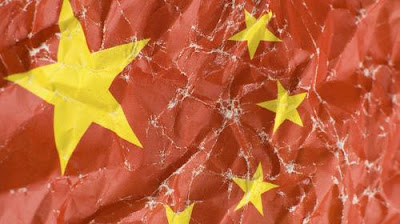
China Communist party since its takingover the leadership of China in 1949 mainly experienced five generation as a top leader in PRC.They are listed as follow:Mao Zedong (毛澤東)/Hua Guofeng (華國鋒)/Deng Xiaoping(鄧小平)/Jiang Zemin(江澤民)/Hu Jintao(胡錦濤)。Thus the sixth chairman in China is Xi Jinping,who just now takes charge of the power from the former leader of Hu Jintao.When is the end of eines Partei Autocratic Road?
Der neue starke Mann in China heißt Xi Jinping. Der 59-Jährige übernimmt die Führung der Kommunistischen Partei und der Streitkräfte. Im März wird er zudem zum Präsidenten des Landes gekürt.
Money,Woman,Power,Corruption,together with CPC
In einer Rede sagte Xi, er werde alles daran setzen, um dem Volk ein besseres Leben zu ermöglichen. Er sprach auch Probleme an: "Unsere Partei ist mit vielen Herausforderungen konfrontiert. Es gibt viele Probleme innerhalb der Partei, die gelöst werden müssen: Korruption auf allen Ebenen, ein Übermaß an Bürokratie und viele Parteimitglieder haben den Kontakt mit der Bevölkerung verloren."
Viele Chinesen begrüßten, dass Xi das Problem der wuchernden Korruption direkt ansprach. Sie hoffen, dass den Worten nun Taten folgen werden:
"In China ist die Schere zwischen Arm und Reich zu groß. Auf dem Land leben viele Menschen in tiefster Armut. Ich hoffe, dass diese Regionen sich in Zukunft entwickeln werden." Ein Mann aus Peking sagte: "Die nächsten zehn Jahre sind für China entscheidend. Wir hoffen, dass sich das Land in dieser Zeit entwickeln und die Regierung frei von Korruption sein wird. Ich bin zuversichtlich."
Xi gilt als Konservativer und will am Sozialismus mit chinesischen Merkmalen festhalten. Auf ihn wartet viel Arbeit, denn Chinas Wirtschaftswachstum hat sich verlangsamt und die sozialen Spannungen lassen sich nicht mehr länger ignorieren.
COMMUNIST PARTY AUTOCRAT
Cry from the whole china against the Despotism party! For Freedom ,for Democracy and Right we desire!
Description about Medical and Pharmaceutical Sealing machine Kartonierer für die pharmazeutische Industrie und andere Pharmaverpackungsmaschinen
The medical paper and plastic bag sealing machine for sealing and parameters of continuous printing, with stable performance, beautiful appearance, convenient operation by the major hospitals of all ages.
Features of sealing machinery:
1. Original German import, performance, stability and security;
2. Using high-quality network just as the shell material, design luxurious, durable;
3. Microprocessor-controlled stamping equipment, large screen multi-function LCD display and program settings can be printed sterilization date, expiry date, batch number, staff ID, CE code and other content, print, adjustable initial margin;
4. Auto calendar, document memory, fonts, optional, adjustable kerning, single print;
5. Print function can be suspended, leaving only the sealing function;
6. Meet the ISO9001, TUV.CE ASTM and other recognized quality standards;
7. Applicable to the norms ISO 11607/EN868-5 products.
Ask anyone which search engine they use to find information on the Internet and they will almost certainly reply: "Google." Look a little further, and market research shows that people actually use four main search engines for 99.99% of their searches: Google, Yahoo!, MSN, and Ask.com (in that order). But in my travels as a Search Engine Optimizer (SEO), I have discovered that in that .01% lies a vast multitude of the most innovative and creative search engines you have never seen. So many, in fact, that I have had to limit my list of the very best ones to a mere 100.
But it's not just the sheer number of them that makes them worthy of attention; each one of these search engines has that standard "About Us" link at the bottom of the homepage. I call it the "why we're better than Google" page. And after reading dozens and dozens of these pages, I have come to the conclusion that, taken as a whole, they are right!
The Search Homepage
In order to address their claims systematically, it helps to group them into categories and then compare them to their Google counterparts. For example, let's look at the first thing that almost everyone sees when they go to search the Internet - the ubiquitous Google homepage. That famously sparse, clean sheet of paper with the colorful Google logo is the most popular Web page in the entire World Wide Web. For millions and millions of Internet users, that Spartan white page IS the Internet.
Google has successfully made their site the front door through which everyone passes in order to access the Internet. But staring at an almost blank sheet of paper has become, well, boring. Take Ms. Dewey for example. While some may object to her sultry demeanor, it's pretty hard to deny that interfacing with her is far more visually appealing than with an inert white screen.
A second example comes from Simply Google. Instead of squeezing through the keyhole in order to reach Google's 37 search options, Simply Google places all of those choices and many, many more all on the very first page; neatly arranged in columns.
Artificial Intelligence
A second arena is sometimes referred to as Natural Language Processing (NLP), or Artificial Intelligence (AI). It is the desire we all have of wanting to ask a search engine questions in everyday sentences, and receive a human-like answer (remember "Good Morning, HAL"?). Many of us remember Ask Jeeves, the famous butler, which was an early attempt in this direction - that unfortunately failed.
Google's approach, Google Answers, was to enlist a cadre of "experts.
" The concept was that you would pose a question to one of these experts, negotiate a price for an answer, and then pay up when it was found and delivered. It was such a failure, Google had to cancel the whole program. Enter ChaCha. With ChaCha, you can pose any question that you wish, click on the "Search With Guide" button, and a ChaCha Guide appears in a Chat box and dialogues with you until you find what you are looking for. There's no time limit, and no fee.
Clustering Engines
Perhaps Google's most glaring and egregious shortcoming is their insistence on displaying the outcome of a search in an impossibly long, one-dimensional list of results. We all intuitively know that the World Wide Web is just that, a three dimensional (or "3-D") web of interconnected Web pages. Several search engines, known as clustering engines, routinely present their search results on a two-dimensional map that one can navigate through in search of the best answer. Search engines like KartOO and Quintura are excellent examples.
Recommendation Search Engines
Another promising category is the recommendation search engines. While Google essentially helps you to find what you already know (you just can't find it), recommendation engines show you a whole world of things that you didn't even know existed. Check out What to Rent, Music Map, or the stunning Live Plasma display. When you input a favorite movie, book, or artist, they recommend to you a world of titles or similar artists that you may never have heard of, but would most likely enjoy.
Metasearch Engines
Next we come to the metasearch engines. When you perform a search on Google, the results that you get are all from, well, Google! But metasearch engines have been around for years. They allow you to search not only Google, but a variety of other search engines too - in one fell swoop. There are many search engines that can do this, Dogpile, for instance, searches all of the "big four" mentioned above (Google, Yahoo!, MSN, and Ask) simultaneously. You could also try Zuula or PlanetSearch - which plows through 16 search engines at a time for you. A very interesting site to watch is GoshMe. Instead of searching an incredible number of Web pages, like conventional search engines, GoshMe searches for search engines (or databases) that each tap into an incredible number of Web pages. As I perceive it, GoshMe is a meta-metasearch engine (still in Beta)!
Other Alt Search Engines
And so it goes, feature after feature after feature. TheFind is a better shopping experience than Google's Froogle, IMHO. Like is a true visual search engine, unlike Google's Images, which just matches your keywords into images that have been tagged with those same keywords. Coming soon is Mobot (see the Demo at www.mobot.com). Google Mobile does let you perform a search on your mobile phone, but check out the Slifter Mobile Demo when you get a chance!
Finally, almost prophetically, Google is silent. Silent! At least Speeglebot talks to you, and Nayio listens! But of course, why should Google worry about these upstarts (all 100 of them)? Aren't they just like flies buzzing around an elephant? Can't Google just ignore them, as their share of the search market continues to creep upwards towards 100%, or perhaps just buy them? Perhaps.
SEARCH ENGINE VS SOCIAL MEDIA
The Last Question
Issac Asimov, the preeminent science fiction writer of our time, once said that his favorite story, by far, was The Last Question. The question, for those who have not read it, is "Can Entropy Be Reversed?" That is, can the ultimate running down of all things, the burning out of all stars (or their collapse) be stopped - or is it hopelessly inevitable?
The question for this age, I submit, is,"Can Google Be Defeated"? Or is Google's mission "to organize the world's information and make it universally accessible and useful" a fait accompli?
Perhaps the place to start is by reading (or re-reading) Asimov's "The Last Question." I won't give it away, but it does suggest The Answer.
Semi automatic cigrette overwrapping packaging machinery&Tobacco PE Film Shrinking Packaging equipment from Guangzhou Lianhe cosmetic&food&pharmaceutical making and packaging machinery is updated and manufactured by our production department this year for marketing our automatic or semi automatic packaging machinery in the light industry.
This bag packaging machinery designed and manufactured by Guangzhou Lianhe cosmetic &food&pharma making and packaging machinery factory shall enjoy 1 year warranty and life-long maintenance service (Remark: Customer should use the consumption material appointed by us, or the failure of machine hereby induced shall not be in the warranty range)
Scope of Application
Suitable for automatic packaging of liquid, cream, paste material of foods, medicine, daily used chemical, farm chemical etc. Such as shampoo, body foam, facial cream, oil, grease, makeup, pesticide, fertilizer,foliage fertilizer, seasoning oil, chili sauce, ketchup and so on.
Technical data
Speed: 20-50 Bags/Min
Packing scope:10-20ml;
Bag Size:(L)50-140、(W)25-80;(cm)
Bag Style: Irregular Shaped Bag (Designed by you)
Power: 2000W
Voltage:220V/50-60Hz;
Packing material:Polyester/aluminum foil/PE,etc.
Net Weight:320kg
Overall Size:1930*750*1800mm
For more information about Guangzhou lianhe packaging equipments like the Irregular shaped bag packaging machinery please feel free to contact us online by email jackdu999@yahoo.com or browse our business blogspot http://cosmeticmachinery.blogspot.com
Lianhe powder filling machine is used for packing all kinds of powder materials in chemical,food,cosmetics as well as medicine industry.The packing materials often include milk powder,legume,powder,cosmetics powder,tea and medical powder and so on.Not only the filling function these machine often have but also they can pack the bags and print the date then.We lianhe certainly can design according our customers requirements the powder filling machine with the weighing system.
The powder filling machines showed in the video is the ones that can fill and pack the milk powder and detergent powder for an automatic production line,by which it can save a lot of manpower ,thus decrease the cost for the enterprises.
Guangzhou lianhe since 1992 has been manufacturing the cosmetic&food making and packaging machinery.In these field we have the experience rich enough to solve the questions encountered by our customers from both home and abroad.For more information about lianhe machinery,please email via or browse our website www.cosmeticmakingmachine.com .
Traditional Chinese medicine (TCM) (simplified Chinese: 中医; traditional Chinese: 中醫; pinyin: zhōng yī; literally "Chinese medicine") is a broad range of medicine practices sharing common theoretical concepts which have been developed in China and are based on a tradition of more than 2,000 years, including various forms of herbal medicine, acupuncture, massage (Tui na),
exercise (qigong), and dietary therapy.The doctrines of Chinese medicine are rooted in books such as the Yellow Emperor's Inner Canon and the Treatise on Cold Damage, as well as in cosmological notions like yin-yang and the five phases. Starting in the 1950s, these precepts were modernized in the People's Republic of China so as to integrate manyanatomical and pathological notions with scientific medicine. Nonetheless, many of its assumptions, including the model of the body, or concept of disease, are not supported by modern evidence-based medicine.
TCM CHRYSANTHEMUM
TCM's view of the body places little emphasis on anatomical structures, but is mainly concerned with the identification of functional entities (which regulate digestion, breathing, aging etc.). While health is perceived as harmonious interaction of these entities and the outside world, disease is interpreted as a disharmony in interaction. TCM diagnosis consists in tracing symptoms patternsof an underlying disharmony, mainly by palpating the pulse and inspecting the tongue.
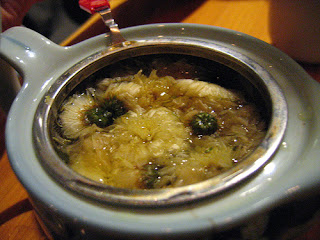
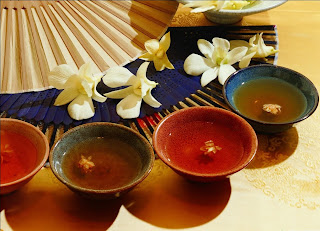
Chrysanthemum tea (Chinese: 菊花茶; pinyin: júhuā chá) is a flower-based tisane made from chrysanthemum flowers of the species Chrysanthemum morifolium or Chrysanthemum indicum,
which are most popular in East Asia. To prepare the tea, chrysanthemum flowers (usually dried) are steeped in hot water (usually 90 to 95 degrees Celsius after cooling from a boil) in either a teapot, cup, or glass; often rock sugar is also added, and occasionally also wolfberries. The resulting drink is transparent and ranges from pale to bright yellow in color, with a floral aroma. In Chinese tradition, once a pot of chrysanthemum tea has been drunk, hot water is typically added again to the flowers in the pot (producing a tea that is slightly less strong); this process is often repeated several times. Chrysanthemum tea was first drunk during the Song Dynasty (960--1279)
CHhrysanthemum Flower
Chrysanthemum tea has many purported medicinal uses, including an aid in recovery from influenza, acne and as a "cooling" herb. According to traditional Chinese medicine the tea can aid in the prevention of sore throat and promote the reduction of fever. In Korea, it is known well for its medicinal use for making people more alert and is often used as a pick-me-up to render the drinker more awake. In western herbal medicine, Chrysanthemum tea is drunk or used as a compress to treat circulatory disorders such as varicose veins and atherosclerosis.
In traditional Chinese medicine, chrysanthemum tea is also said to clear the liver and the eyes.It is believed to be effective in treating eye pain associated with stress or yin/fluid deficiency. It is also used to treat blurring, spots in front of the eyes, diminished vision, and dizziness. The liver is associated with the element Wood which rules the eyes and is associated with anger, stress, and related emotions. No scientific studies have substantiated these claims.
Chrysanthemum Tea
Although typically prepared at home, chrysanthemum tea is also available as a beverage in many Asian restaurants (particularly Chinese ones), and is also available from various drinks outlets in East Asia as well as Asian grocery stores outside Asia in canned or packed form. Due to its medicinal value, it may also be available at Traditional Chinese medicine outlets, often mixed with other ingredients.
Healthy eating and diet like fruit vegetable&meat gesunde Ernährung Lebensmittel fuer Mensch from professional video in the channal health medicine as well as sports.
Everyone wants to be healthy, and that's a fact. Now in these days of glorious burgers and fries,
how can you maintain being fit and healthy? The answer still is the same since time immemorial. Good food, exercise, and a healthy lifestyle. Yeah still these stuff are the three kings, but how do you define good health food anyway? Here are a few tips that will help ya.
•All natural food is healthy. Taken in moderation, non-processed foods are good for your body. But don't take the misconception that processed foods are bad. Because they aren't bad either, when taken in moderation that is. So the secret lies in control of food intake, as whether your food is bad or good depends primarily on how you control it.
Green Leaves Vegetable
•The food you should take is in complimentary to your level and kind of activity. Did you know that your brain only accepts sugars, primarily glucose as it's source of energy? Contrary to the heart and muscle cells, which can utilize fatty acids as its energy source, your brain is very picky to what it takes. Hence if your work is all about thinking and using your brain, you should eat more carb and less fatty foods. As you won't be able to utilize fats and they'll likely get stored in your body. On the other hand, if your work is all about muscles, then you're welcome to have a higher portion of fats in your diet.
Healthy diet in your hand
•Not all fats are equal. Just like how not all people are equal, there are also differences with the kinds of fats. The two primary groups of fats are named the 'saturated' (chemically speaking, they're those that doesn't have double bonds in their structure) and the 'unsaturated' (those with double bonds in their chemical structure).
When going for fatty foods, you might want to look for unsaturated fats because these are the ones healthier. Saturated fats account for most of the deadly diseases as these fats tend to clump up and stick together thus blocking blood vessel pathways.
Basically, fats that come from animal sources have high ration of saturated-to-unsaturated hence they should be taken in moderation. Beef fat has the highest while fish fats have more unsaturated fats. Those coming from plant sources tend to be in the middle in terms of this ratio.