Gesundheit für Kinder nach der TCM Traditional Chinese Medicine for the health of Children
Als traditionelle chinesische Medizin,
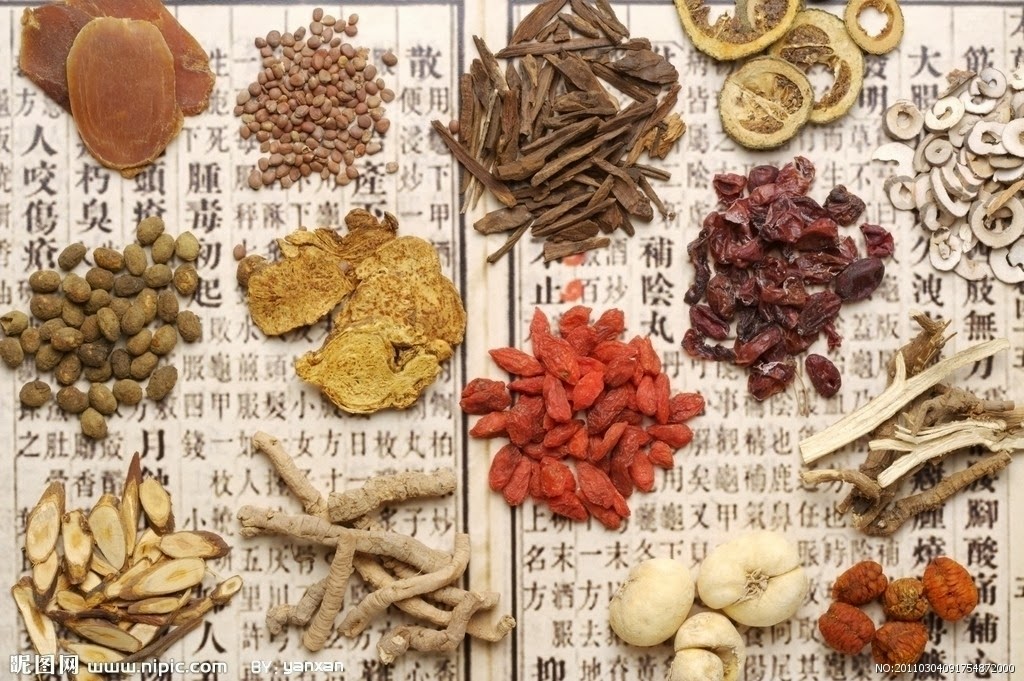
TCM oder chinesische Medizin wird jene Heilkunde bezeichnet, die sich in China seit mehr als 2000 Jahren entwickelt hat. Ihr ursprüngliches Verbreitungsgebiet umfasst den ostasiatischen Raum, insbesondere Vietnam, Korea und Japan. Auf dieser Grundlage entwickelten sich spezielle Varianten in diesen Ländern. Besonders bekannt ist die japanische Kampo-Medizin.
Zu den therapeutischen Verfahren der chinesischen Medizin zählen vor allem deren Arzneitherapie und die Akupunktur sowie die Moxibustion (Erwärmung von Akupunkturpunkten). Zusammen mit Massagetechniken wie Tuina Anmo und Shiatsu, mit Bewegungsübungen wie Qigong und Taijiquan und mit einer am Wirkprofil der Arzneien ausgerichteten Diätetik werden die Verfahren heute gerne als die „fünf Säulen" der chinesischen Therapie bezeichnet. Die TCM ist die traditionelle Medizin mit dem größten Verbreitungsgebiet, besonders die Akupunktur wird heute weltweit praktiziert.Die TCM gilt als alternativ- oder komplementärmedizinisches Verfahren. Das größte einschlägige Forschungszentrum ist die Chinesische Akademie für traditionelle chinesische Medizin.
Von wissenschaftlicher Seite, insbesondere der evidenzbasierten Medizin, wird die therapeutische Wirksamkeit vieler Behandlungsmethoden der TCM bestritten. Viele Annahmen der TCM widersprechen naturwissenschaftlichen Erkenntnissen. Einige empirisch belegte Wirkungen werden auf Placeboeffekte zurückgeführt.
Mehr info zum http://cosmeticfoodmakingpackaging.blogspot.com
Diabetes Mellitus is a syndrome characterized by hyperglycemia resulting from impaired insulin secretion and /or effectiveness. There are many complications of diabetes such as retinopathy, nephropathy, atherosclerotic coronary and peripheral arterial disease and peripheral and autonomic neuropathies. There are two types of diabetes IDDM (type: insulin Dependent) and NIDDM (type II: Non insulin dependent DM).
Diabetes is called Xiao Ke in Chinese Medicine. It is believed there are three major organs involved in the disease. They are the lungs, stomach and kidney organs. There are three types (patterns) Xiao Ke (diabetes) classified by Chinese Medicine according to the patient's clinical symptoms, pulse and tongue and which organs are mainly involved
What causes Xiao Ke (diabetes) in the Chinese Medicine point of view? It is believed that people who indulged in alcohol and sweet and/or greasy foods and have an irregular, unhealthy and sedentary lifestyle are prone to develop Xiao Ke diseases. This lifestyle easily consumes and blocks the body's energy. Once the body's energy is blocked, there is stagnation and eventually, toxic heat will be generated. The toxic heat will further consume the vital organ's fluid and cause organ malfunction and disharmony. The lung organ, spleen and kidney have not been in harmony for a long time before Xiao Ke (diabetes) develops.
The first step to treating and/or preventing diabetes is to start with exercising regularly and food therapy such as the Chinese diet therapy (Chinese Yao Shan.) Recently research indicates that our muscles transport blood glucose into the muscle cells to lower blood sugar level without the need of insulin during muscle exercise. That is the reason exercise is important in preventing diabetes and helping to control blood sugar. The increased circulation prevents and helps in delaying any degenerating complication such as neuropathy.
For more information about health medicine sports browse channal at http://youtube.com/user/cosmeticmachines
kidney function in animation how our Kidney Works Wie funktioniert die Niere 私たちの腎臓のしくみ
We can live quite well with only one kidney and some people live a healthy life even though born with one missing. But while bones can break, muscles can waste away and the brain can sleep without risk to life, if both of your kidneys fail, as happens in end stage kidney failure, bone, muscle or brain can not carry on.
How do our kidneys work?
Think of your kidneys as an extremely sophisticated, waste disposal system, which sorts non-recyclable waste from recyclable waste, 24 hours a day, 7 days a week, while also cleaning your blood. Much of this waste is produced by the body as it processes the food you eat.
Without any kidney function our body dies. Some kidney function is essential for life!
Most people are born with two kidneys, each one about the size of an adult fist, are bean-shaped and weigh around 150 grams each. The kidneys are located at both sides of your backbone, just under the rib cage or above the small of your back. They are protected from injury by a large padding of fat, your lower ribs and several muscles.
What do your kidneys do?
Our kidneys are small biological marvels with a fascinating design. Healthy kidneys act like a filter to make sure the right amount of wastes and fluids are removed. Every hour your blood supply circulates through the kidneys about 12 times. Each day your kidneys process around 200 litres of blood, with around 1 to 2 litres of waste leaving the body as urine. Our kidneys make three important hormones, erythropoietin, renin and active vitamin D. Erythropoietin stimulates the production of red blood cells, renin is involved in the control of blood pressure and active vitamin D controls calcium uptake and helps make strong bones.
What is the role of your kidneys in keeping you healthy?
For organs so small, your kidneys works hard - they have a number of vital roles to play in the daily functions of our body, as they:
act as filters for your body to clean blood of wastes, yet retain essential elements needed by the body
they keep the proper balance of salts and acids in the body, and produce hormones and enzymes which help to:
control your blood pressure
help to keep your internal water balance
make red blood cells and help maintain your blood composition and pH levels
maintain strong and healthy bones and help to keep mineral balance
Your kidneys are master chemists of the body, intervene in many processes and balances in the body and control many vital body functions. The major role of the kidneys is to remove waste from the blood and eliminate it in the urine. To remove this waste and extra water, blood enters the kidney through the renal artery; blood is then cleaned in the kidney as it passes through tiny filters called nephrons. The nephrons are the basic working units of the kidneys, controlling the formation of urine. One kidney contains about one million nephrons, and each nephron contains a filtering apparatus called a glomerulus.
Anatomy of the kidneys
We have about a million hairpin-like glomeruli at birth, but lose about 100,000 of these every decade of life. Droplets of filtered blood pass through a number of tubules (tiny tubes) into the medulla, a central collecting region. The glomeruli and tubules together make up nephrons, long and extremely fine tubes which, if connected, would run for 80 kilometres (50 miles).
Cleaned blood returns to the body by the renal vein. Waste and extra water removed by the kidney passes through a tube called the ureter to the bladder, where it is stored as urine or wee. When the bladder is full, urine passes out of the body through another tube called the urethra.
The process of removing waste and extra water in simple terms is:
food and drink enters the stomach and are broken down into nutrients
solid waste products are removed and nutrients enter the bloodstream.
nutrients are used by the body for energy, growth, repair and maintenance of body functions.
this process creates waste which is removed by the kidneys.
extra nutrients not immediately needed by the body are also removed by the kidneys.
waste products and extra water move from the kidneys to the bladder, then leave the body as urine
Traditional Chinese medicine (TCM) (simplified Chinese: 中医; traditional Chinese: 中醫; pinyin: zhōng yī; literally "Chinese medicine") is a broad range of medicine practices sharing common theoretical concepts which have been developed in China and are based on a tradition of more than 2,000 years, including various forms of herbal medicine, acupuncture, massage (Tui na),
exercise (qigong), and dietary therapy.The doctrines of Chinese medicine are rooted in books such as the Yellow Emperor's Inner Canon and the Treatise on Cold Damage, as well as in cosmological notions like yin-yang and the five phases. Starting in the 1950s, these precepts were modernized in the People's Republic of China so as to integrate manyanatomical and pathological notions with scientific medicine. Nonetheless, many of its assumptions, including the model of the body, or concept of disease, are not supported by modern evidence-based medicine.
TCM CHRYSANTHEMUM
TCM's view of the body places little emphasis on anatomical structures, but is mainly concerned with the identification of functional entities (which regulate digestion, breathing, aging etc.). While health is perceived as harmonious interaction of these entities and the outside world, disease is interpreted as a disharmony in interaction. TCM diagnosis consists in tracing symptoms patternsof an underlying disharmony, mainly by palpating the pulse and inspecting the tongue.
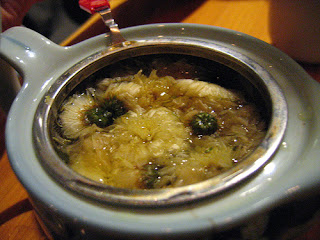
Chrysanthemum tea (Chinese: 菊花茶; pinyin: júhuā chá) is a flower-based tisane made from chrysanthemum flowers of the species Chrysanthemum morifolium or Chrysanthemum indicum,
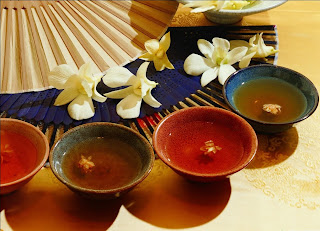
which are most popular in East Asia. To prepare the tea, chrysanthemum flowers (usually dried) are steeped in hot water (usually 90 to 95 degrees Celsius after cooling from a boil) in either a teapot, cup, or glass; often rock sugar is also added, and occasionally also wolfberries. The resulting drink is transparent and ranges from pale to bright yellow in color, with a floral aroma. In Chinese tradition, once a pot of chrysanthemum tea has been drunk, hot water is typically added again to the flowers in the pot (producing a tea that is slightly less strong); this process is often repeated several times. Chrysanthemum tea was first drunk during the Song Dynasty (960--1279)
CHhrysanthemum Flower
Chrysanthemum tea has many purported medicinal uses, including an aid in recovery from influenza, acne and as a "cooling" herb. According to traditional Chinese medicine the tea can aid in the prevention of sore throat and promote the reduction of fever. In Korea, it is known well for its medicinal use for making people more alert and is often used as a pick-me-up to render the drinker more awake. In western herbal medicine, Chrysanthemum tea is drunk or used as a compress to treat circulatory disorders such as varicose veins and atherosclerosis.
In traditional Chinese medicine, chrysanthemum tea is also said to clear the liver and the eyes.It is believed to be effective in treating eye pain associated with stress or yin/fluid deficiency. It is also used to treat blurring, spots in front of the eyes, diminished vision, and dizziness. The liver is associated with the element Wood which rules the eyes and is associated with anger, stress, and related emotions. No scientific studies have substantiated these claims.
Chrysanthemum Tea
Although typically prepared at home, chrysanthemum tea is also available as a beverage in many Asian restaurants (particularly Chinese ones), and is also available from various drinks outlets in East Asia as well as Asian grocery stores outside Asia in canned or packed form. Due to its medicinal value, it may also be available at Traditional Chinese medicine outlets, often mixed with other ingredients.