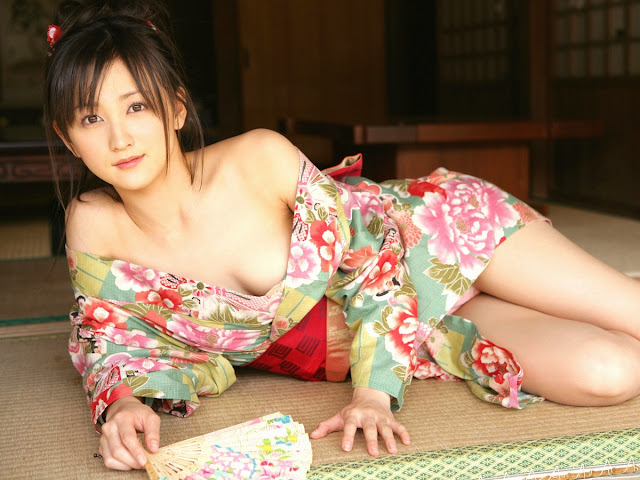
If you want to overcome hime you must first learn of him,just as a famous motto tells us"there is no fail in the war if you know clearly both you and your enemy".
About Japan,we cannot only addict ourself into its AV or sex culture as well as animation,by which japanese can invade china in another way to nipkap the thought of the yougth.Beyond the AV and animation,we must know in this country there exists the long military history,perverse infatuation in the warrior spirit,modern electric technology,no mention the deeply envolved conflicts with china since the Ming Dynasty.
How to learn of your opponent is up to your blind-blieve but to the objective oppinion on the reality.Below the the wikipedia about the introduction of japan.
Japan i/dʒəˈpæn/ (Japanese: 日本 Nihon or Nippon; formally 日本国 Nippon-koku or Nihon-koku, literally "[the] State of Japan") is an island nation in East Asia. Located in the Pacific Ocean, it lies to the east of the Sea of Japan, China, North Korea, South Korea and Russia, stretching from the Sea of Okhotsk in the north to the East China Sea and Taiwan in the south. The characters that make up Japan's name mean "sun-origin", which is why Japan is sometimes referred to as the "Land of the Rising Sun".
Japan
is an archipelago of 6,852 islands. The four largest islands are Honshu, Hokkaido, Kyushu, and Shikoku, which together comprise about ninety-seven percent of Japan's land area. Japan has the world's tenth-largest population, with over 127 million people. Honshū's Greater Tokyo Area, which includes the de facto capital city of Tokyo and several surrounding prefectures, is the largest metropolitan area in the world, with over 30 million residents. Archaeological research indicates that people lived in Japan as early as the Upper Paleolithic period. The first written mention of Japan is in Chinese history texts from the 1st century AD. Influence from other nations followed by long periods of isolation has characterized Japan's history. From the 12th century until 1868, Japan was ruled by successive feudal military dictatorships (shogunates) in the name of the Emperor.Japan entered into a long period of isolation in the early 17th century, which was only ended in 1853 when a United States fleet pressured Japan to open to the West. Nearly two decades of internal conflict and insurrection followed before the Meiji Emperor was restored as head of state in 1868 and the Empire of Japan was proclaimed, with the Emperor as a divine symbol of the nation. In the late 19th and early 20th centuries, victory in the First Sino-Japanese War, the Russo-Japanese War and World War I allowed Japan to expand its empire during a period of increasing militarism. The Second Sino-Japanese War of 1937 expanded into part of World War II in 1941, which came to an end in 1945 following the atomic bombings of Hiroshima and Nagasaki. Since adopting its revised constitution in 1947, Japan has maintained a unitary constitutional monarchy with an emperor and an elected legislature called the Diet.
A major economic power,
Japan
has the world's third-largest economy by nominal GDP and by purchasing power parity. It is also the world's fourth-largest exporter and fourth-largest importer. Although Japan has officially renounced its right to declare war, it maintains a modern military with the sixth largest military budget,used for self-defense and peacekeeping roles. After Singapore, Japan has the lowest homicide rate (including attempted homicide) in the world. According to Japan's health ministry, Japanese women have the second highest life expectancy of any country in the world.According to the United Nations, Japan also has the third lowest infant mortality rate.
In Lin Yutang's our country our people,the great writer to the point describes the vanity of our people but meantime he cherish love in this country and people.Currently many chinese and her populace illusion themselves to many sky thoughts about the china and its potential enemy Japan,thus willing to be an animal buring his side in the sand.Open your eyes to see through the world,only these who all the time keep their eyes close know nothing but the darkness!
To Know Japan in 2 Minutes 兩分鐘瞭解日本 日本を知道するには、2つの分
Traditional Chinese medicine (TCM) (simplified Chinese: 中医; traditional Chinese: 中醫; pinyin: zhōng yī; literally "Chinese medicine") is a broad range of medicine practices sharing common theoretical concepts which have been developed in China and are based on a tradition of more than 2,000 years, including various forms of herbal medicine, acupuncture, massage (Tui na),
exercise (qigong), and dietary therapy.The doctrines of Chinese medicine are rooted in books such as the Yellow Emperor's Inner Canon and the Treatise on Cold Damage, as well as in cosmological notions like yin-yang and the five phases. Starting in the 1950s, these precepts were modernized in the People's Republic of China so as to integrate manyanatomical and pathological notions with scientific medicine. Nonetheless, many of its assumptions, including the model of the body, or concept of disease, are not supported by modern evidence-based medicine.
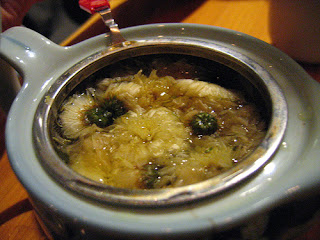
TCM CHRYSANTHEMUM
TCM's view of the body places little emphasis on anatomical structures, but is mainly concerned with the identification of functional entities (which regulate digestion, breathing, aging etc.). While health is perceived as harmonious interaction of these entities and the outside world, disease is interpreted as a disharmony in interaction. TCM diagnosis consists in tracing symptoms patternsof an underlying disharmony, mainly by palpating the pulse and inspecting the tongue.
Chrysanthemum tea (Chinese: 菊花茶; pinyin: júhuā chá) is a flower-based tisane made from chrysanthemum flowers of the species Chrysanthemum morifolium or Chrysanthemum indicum,
which are most popular in East Asia. To prepare the tea, chrysanthemum flowers (usually dried) are steeped in hot water (usually 90 to 95 degrees Celsius after cooling from a boil) in either a teapot, cup, or glass; often rock sugar is also added, and occasionally also wolfberries. The resulting drink is transparent and ranges from pale to bright yellow in color, with a floral aroma. In Chinese tradition, once a pot of chrysanthemum tea has been drunk, hot water is typically added again to the flowers in the pot (producing a tea that is slightly less strong); this process is often repeated several times. Chrysanthemum tea was first drunk during the Song Dynasty (960--1279)
CHhrysanthemum Flower
Chrysanthemum tea has many purported medicinal uses, including an aid in recovery from influenza, acne and as a "cooling" herb. According to traditional Chinese medicine the tea can aid in the prevention of sore throat and promote the reduction of fever. In Korea, it is known well for its medicinal use for making people more alert and is often used as a pick-me-up to render the drinker more awake. In western herbal medicine, Chrysanthemum tea is drunk or used as a compress to treat circulatory disorders such as varicose veins and atherosclerosis.
In traditional Chinese medicine, chrysanthemum tea is also said to clear the liver and the eyes.It is believed to be effective in treating eye pain associated with stress or yin/fluid deficiency. It is also used to treat blurring, spots in front of the eyes, diminished vision, and dizziness. The liver is associated with the element Wood which rules the eyes and is associated with anger, stress, and related emotions. No scientific studies have substantiated these claims.
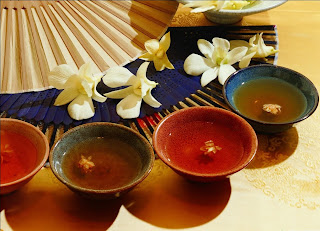
Chrysanthemum Tea
Although typically prepared at home, chrysanthemum tea is also available as a beverage in many Asian restaurants (particularly Chinese ones), and is also available from various drinks outlets in East Asia as well as Asian grocery stores outside Asia in canned or packed form. Due to its medicinal value, it may also be available at Traditional Chinese medicine outlets, often mixed with other ingredients.