Traditional Chinese medicine (TCM) (simplified Chinese: 中医; traditional Chinese: 中醫; pinyin: zhōng yī; literally "Chinese medicine") is a broad range of medicine practices sharing common theoretical concepts which have been developed in China and are based on a tradition of more than 2,000 years, including various forms of herbal medicine, acupuncture, massage (Tui na),
exercise (qigong), and dietary therapy.The doctrines of Chinese medicine are rooted in books such as the Yellow Emperor's Inner Canon and the Treatise on Cold Damage, as well as in cosmological notions like yin-yang and the five phases. Starting in the 1950s, these precepts were modernized in the People's Republic of China so as to integrate manyanatomical and pathological notions with scientific medicine. Nonetheless, many of its assumptions, including the model of the body, or concept of disease, are not supported by modern evidence-based medicine.
TCM CHRYSANTHEMUM
TCM's view of the body places little emphasis on anatomical structures, but is mainly concerned with the identification of functional entities (which regulate digestion, breathing, aging etc.). While health is perceived as harmonious interaction of these entities and the outside world, disease is interpreted as a disharmony in interaction. TCM diagnosis consists in tracing symptoms patternsof an underlying disharmony, mainly by palpating the pulse and inspecting the tongue.
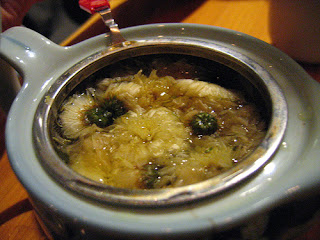
Chrysanthemum tea (Chinese: 菊花茶; pinyin: júhuā chá) is a flower-based tisane made from chrysanthemum flowers of the species Chrysanthemum morifolium or Chrysanthemum indicum,
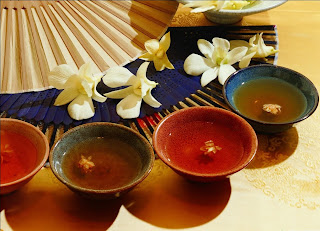
which are most popular in East Asia. To prepare the tea, chrysanthemum flowers (usually dried) are steeped in hot water (usually 90 to 95 degrees Celsius after cooling from a boil) in either a teapot, cup, or glass; often rock sugar is also added, and occasionally also wolfberries. The resulting drink is transparent and ranges from pale to bright yellow in color, with a floral aroma. In Chinese tradition, once a pot of chrysanthemum tea has been drunk, hot water is typically added again to the flowers in the pot (producing a tea that is slightly less strong); this process is often repeated several times. Chrysanthemum tea was first drunk during the Song Dynasty (960--1279)
CHhrysanthemum Flower
Chrysanthemum tea has many purported medicinal uses, including an aid in recovery from influenza, acne and as a "cooling" herb. According to traditional Chinese medicine the tea can aid in the prevention of sore throat and promote the reduction of fever. In Korea, it is known well for its medicinal use for making people more alert and is often used as a pick-me-up to render the drinker more awake. In western herbal medicine, Chrysanthemum tea is drunk or used as a compress to treat circulatory disorders such as varicose veins and atherosclerosis.
In traditional Chinese medicine, chrysanthemum tea is also said to clear the liver and the eyes.It is believed to be effective in treating eye pain associated with stress or yin/fluid deficiency. It is also used to treat blurring, spots in front of the eyes, diminished vision, and dizziness. The liver is associated with the element Wood which rules the eyes and is associated with anger, stress, and related emotions. No scientific studies have substantiated these claims.
Chrysanthemum Tea
Although typically prepared at home, chrysanthemum tea is also available as a beverage in many Asian restaurants (particularly Chinese ones), and is also available from various drinks outlets in East Asia as well as Asian grocery stores outside Asia in canned or packed form. Due to its medicinal value, it may also be available at Traditional Chinese medicine outlets, often mixed with other ingredients.